Politics
Johnson Defends Budget Proposal, Says Taxing Corporations Is a ‘Reasonable Expectation’
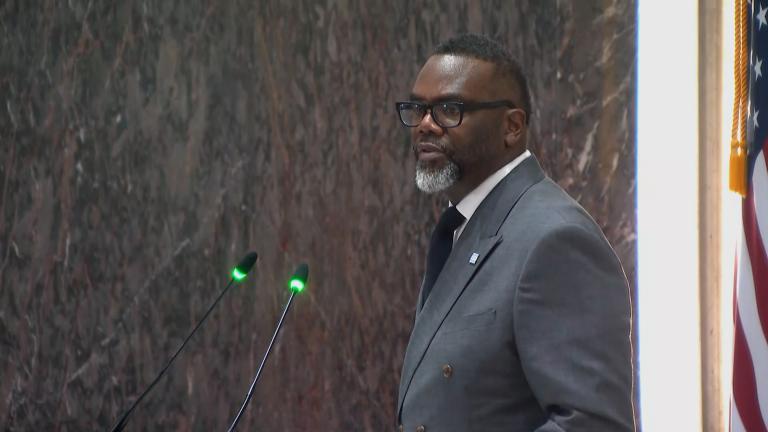
Mayor Brandon Johnson is fighting for his political life on two fronts.
In February, he’ll face voters and up to 15 challengers in his bid for a second term on City Hall’s fifth floor. But before then, he’ll work to sway some of the stiff opposition among City Council members who successfully passed their own version of a budget last year.
Johnson last week introduced his $17.6 billion budget proposal, which includes new spending on city services and hundreds of millions of dollars in borrowing to resolve police misconduct lawsuits — but avoids raising property taxes.
The item that’s drawing the most attention is the revival of a corporate head tax proposal, less than a year after a majority of the City Council rejected the idea. And despite warnings from those same alderpeople this year, Johnson isn’t backing down from the fight.
“Challenging corporations and the ultra-wealthy to pay their fair share, that’s a reasonable expectation,” Johnson said Thursday in an interview with WTTW News.
“I’m taking my budget proposal right to the community. … My team has made a commitment to reach out to every single alderperson every day,” Johnson said. “I reached out to a few of them just yesterday.”
The city’s top financial officials have defended the head tax in hearings this week, but it’s not clear whether the reception from the mayor’s opponents will get any warmer.
Ald. Bill Conway (34th Ward) told WTTW News last week that “to tax the behavior we’re trying to create just doesn’t make sense. … We beat this dead horse to death last year, and why (supportive alderpeople) and the mayor want to exorcise it, I can’t tell you.”
The head tax proposal in this year’s budget proposal stands at $25 per employee for firms with more than 125 employees. But firms would also receive a tax credit for every employee based in a government-designated socioeconomically disadvantaged area.
“Bringing that investment into areas that have been historically underserved is exactly what we want to do,” Ald. Jason Ervin (28th Ward), chair of the Budget Committee, said last week.
In addition to asking corporations to pay “their fair share,” Johnson also highlighted his proposals to reopen a mental health clinic, expand youth jobs programs and boost the public library budget among other investments.
Addressing criticisms that a head tax could push jobs out of the city, Johnson said “the city of Chicago has experienced a revolution, quite frankly,” and added that his record on public safety delivers on a major request from the business community.
“Having some predictability around what revenue streams we will rely upon and driving violence down, those were always two of the top three aspects that I’ve heard from every single resident and constituent and stakeholder,” Johnson said.
His administration expects a corporate head tax to generate roughly $100 million.
Johnson’s proposal to borrow $481 million to resolve police misconduct lawsuits has also raised eyebrows. At current borrowing rates, the city’s CFO Ashlee Gabrysh expects this borrowing to come with $190 million in interest.
City leaders, including former corporation counsel Mary Richardson-Lowry, have recently moved toward global settlements for police misconduct cases that come with larger up-front costs, but with an expectation they will save hundreds of millions of dollars in legal fees in the long run.
“Addressing this is something that I think the people of Chicago deserve,” Johnson said. “There’s no easy path forward.”
Johnson said the majority of this money will go to resolving cases tied to former Chicago police Detective Reynaldo Guevara and former Sgt. Ronald Watts.
Spending to resolve decades-old misconduct cases, however, isn’t the only police spending drawing scrutiny. Between 2023 and 2025, CPD overspent its budget by $520 million.
Johnson said the steps he’s taken to rein in this spending include a public-facing dashboard and a monthly review on overtime pay.
And while the election looms large over this budget season, so does the threat of another credit downgrade that could push borrowing costs up even higher.
Credit rating agencies have warned that political fighting and a failure to address structural budget challenges are a cause for concern. On the latter point, Johnson took another shot at what he sees as the shortcomings of last year’s alternative budget, which he allowed to take effect without his signature.
“Unfortunately, City Council moved on speculative revenue sources that turned out to be not only ineffective, but they didn’t yield any real revenue,” Johnson said. “The City Council’s made a commitment that they’re not going to do that again, which is a good sign that they’ve learned that lesson.”
But as for political fighting?
“Having a back and forth in a budget — that’s normal,” Johnson said.
Heather Cherone contributed to this report.
Related Stories